Win a free book every month. Enter the giveaway
Order by December 1 for Christmas delivery. Give it now
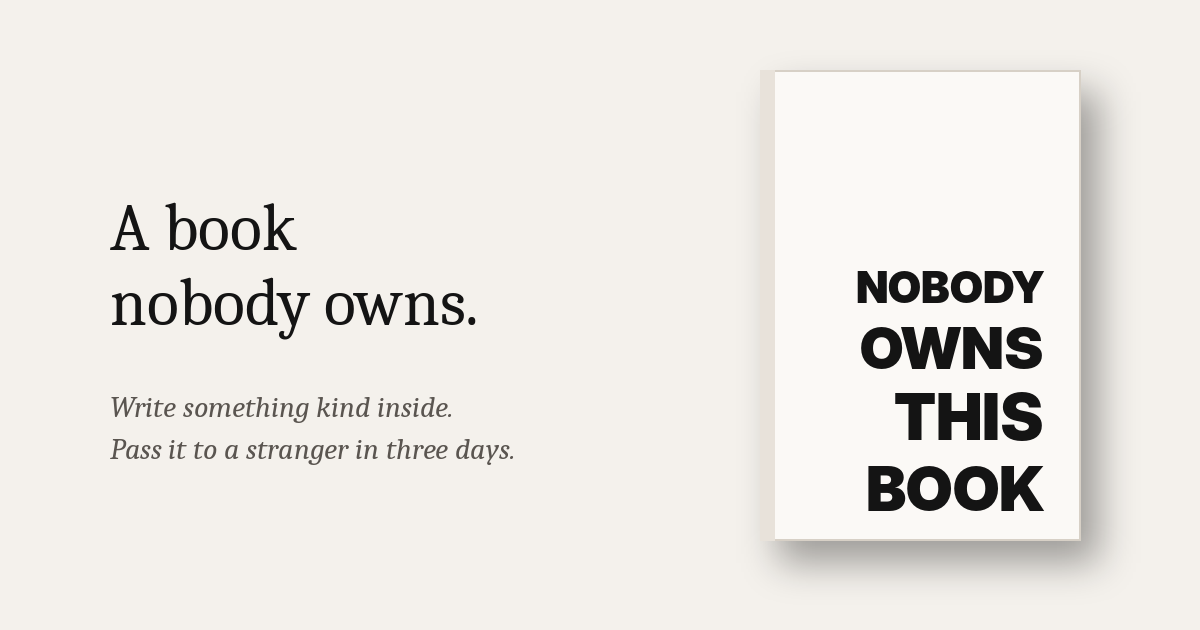
Nobody Owns This Book

An art project nobody owns

The perfect gift for the magical ones in your life

A book they write in, keep for three days, and then set free. A birthday present that becomes a journey, protected by those in the know.

Nobody Owns This Book Begin the journey ↓
Give itto someone magical
They writetheir coordinates and their truths
They let it goand a stranger's story begins

Chapter I

The Invitation

You did not find this page by accident. Nothing about this book happens by accident, even when it looks like an accident. Especially then.

Somewhere right now, a copy of Nobody Owns This Book is resting where it was left on purpose. Maybe it's on a café windowsill with a little steam from someone's latte still fogging the glass. Maybe it's on a train seat, warm from the last person who sat there. Maybe it's tucked between two library books that have nothing to do with it, waiting for the one curious hand that pulls it out. It is not lost. It is traveling.

This is a book you give to someone, and then that someone gives it away. It is a book you write in, and then strangers write in it too. It is a book that ends up in places you will never visit, carried by people you will never meet, holding words you will never read. And that is the whole point.

We call it an art project, but it doesn't sit still long enough to be hung on a wall. We call it a gift, but the person who receives it doesn't get to keep it. We call it a book, but you will write more of it than we did.

So here is the invitation, plainly: give this to someone magical. Someone who notices things. Someone who still makes wishes on eyelashes and talks to dogs like they're people. Someone who would read the first page, smile at the strange rules inside, and then actually follow them.

They will write the time, the date and the place on the first open line, lifting the anchor and launching the book into the timeline. They will answer the prompts inside. They will draw, scribble, press a leaf, leave a secret. And then, within a few days, they will do the bravest and most delightful thing a person can do with a gift: they will let it go.

That's the gift. Not the paper. Not the cover. The moment. The look on their face when they realize what they're holding. The quiet thrill of leaving it somewhere for a stranger. The way it keeps traveling long after the birthday candles are out.

Most gifts end up on a shelf. This one ends up on a journey.

Keep reading. Every chapter on this page opens another door, and a few of them are sealed. You'll know what to do when you get there.

Chapter II

For the Magical Ones

You know exactly who we mean. Everyone has at least one.

The magical ones are the friends who turn a Tuesday into a story. They hum while they cook. They leave notes in library books. They remember your dog's birthday. They pick up interesting rocks and keep them in their coat pockets for years. They stop to watch the sky change color, and they make you stop too.

The magical ones are the aunt who mails postcards from towns you've never heard of. The coworker who keeps a jar of tiny folded wishes on their desk. The kid who asks the question nobody else thought to ask. The grandfather who still writes letters by hand. The roommate who can't walk past a street musician without dropping something in the case. The partner who believes, quietly and completely, that the world is stranger and kinder than it looks.

They are not always loud. Sometimes the magical ones are the quiet ones, the noticers, the ones who see the moss on the sidewalk and the light through the leaves. Sometimes they are the funniest people you know. Sometimes they are the most serious. What they share is a willingness to participate in the world, rather than just consume it.

Ordinary gifts make magical people feel a little invisible. Another candle. Another mug. Another gift card. They'll smile and thank you, because they are kind, but you'll both know.

This gift is different. It speaks their language. It says: I know you are the kind of person who would understand this. It says: I trust you with something that matters. It says: I see the part of you that believes in strangers and small miracles.

There's a reason people go quiet for a second when they open it. They're realizing that someone looked at them and saw the magic. That's a rare feeling. It might be the best thing you can give anyone.

And here's the part that makes the magical ones light up: the book doesn't end with them. They get to pass the magic forward. They get to choose the next stranger, the next café, the next park bench. They get to become, for a moment, the mysterious benefactor in somebody else's story.

If you've been looking for the gift that finally matches the person, you've found it. If you're not sure whether someone in your life counts, there's a little test further down the page. (Spoiler: if you're thinking of them right now, they probably count.)

Is someone in your life one of the magical ones?

Think of them, and tick everything that's true.

Chapter III

The Perfect Birthday Present

A birthday is a coordinate. A single point on the map of a life: this person, this date, this place, one more trip around the sun. Nobody Owns This Book begins exactly the same way, with a time, a date and a place written on the first open line. That's why it makes such a ridiculously good birthday present. The book starts where the birthday is.

Picture it. The candles are out. The wrapping paper is in a heap. They open this, and inside are strange, beautiful rules: they are not the owner, only a passing protector. They must find ink and leave a trace. They have exactly three days to absorb what's inside. And then they must let it go.

They'll laugh. Then they'll read the rules again. Then they'll look up at you, and you'll see it land: you gave me an adventure.

Here's why it works for nearly every age:

For the friend turning 21, 30, 40 or 80: it's a ritual for a milestone. Write down where you are in life on the day you hold it, then send that version of yourself out into the world.

For the person who has everything: they don't have this, because nobody has this. That's the point.

For the person who hates clutter: it's the only gift that's guaranteed to leave the house within days, on purpose, by design.

For the sentimental one: they get to leave a piece of their birthday inside a book that will travel farther than they might ever go.

For the adventurer: it's a quest. Where will they leave it? How far will it go?

For the shy one: they get to be brave anonymously. Nobody needs to know which handwriting was theirs.

A birthday present usually celebrates the past year. This one launches the next one. It turns their birthday into the first stop on a journey that keeps going.

Bonus move: write your birthday message on a separate card and tuck it inside the cover. They can keep the card forever. The book, they'll give away. One is a keepsake. The other is a legend.

And if you're running late (it happens to the best of us), the gift is in the idea as much as the object. Tell them the book is coming, describe the rules, and watch their face. Anticipation is part of the magic.

Chapter IV

You Bought It. You Don't Own It.

This is the sentence that confuses people for exactly two seconds and then never leaves their heads.

You can pay for this book. You can hold it, write in it, carry it in your bag and read it in bed. But you do not own it. Nobody does. That's not a trick of the light or a gimmick printed on the cover. It's the whole design.

Think about how much of our lives is organized around owning things. We buy, we store, we protect, we upgrade. Our closets fill up. Our shelves fill up. Our phones fill up. Most of what we own, we stop noticing within a week.

Now think about the things that actually change us. A conversation with a stranger on a long bus ride. A song someone played you once. A note left on a windshield. A trip you took when you were young and broke. None of those things were possessions. You couldn't keep them. You could only pass through them, and let them pass through you.

Nobody Owns This Book is built to feel like that. It's an object that behaves like an experience. You hold it for a short while. You leave something of yourself inside. And then it goes on without you, carrying your trace to someone else.

There's a lovely kind of freedom in it. You don't have to worry about keeping it nice. You don't have to find a place for it on the shelf. You don't have to decide whether it's "yours." The decision has already been made, and the answer is: it's everyone's, for a little while.

People sometimes ask whether this makes the book a bad gift. Why would you give someone something they can't keep?

Because the best gifts were never about keeping. The best gifts are about feeling. The feeling of being trusted with something. The feeling of being part of something bigger. The feeling of opening a book and seeing handwriting from someone in another city, or another country, who held this exact object before you did.

That feeling stays. It's the only thing anyone gets to keep.

So yes: you'll buy it. And then you'll give it away. And someday, somewhere you've never been, a stranger will open it and find what the person you love wrote inside. That's not losing a gift. That's multiplying it.

Chapter V

An Art Project That Refuses to Behave

Close your eyes and imagine an art project. You probably see a white wall, a frame, a little card with a title and a price, and a polite distance between you and the work. Look, don't touch. The artist made it. You admire it. Everyone goes home.

Now throw all of that out.

Nobody Owns This Book is an art project, but it breaks almost every rule of what an art project is supposed to be.

There is no single artist. We made the first pages. Every person who holds it adds to it. By the time a copy has traveled for a year, most of the art inside was made by strangers.

There is no gallery. The book is shown in cafés, on buses, in parks, at airports, in libraries, in the hands of whoever finds it next.

There is no audience. Everyone who touches it becomes a participant. You can't look at it without being invited to change it.

There is no finished piece. It is never complete. Every copy is a work in progress until it disappears, and even then, the story of where it went keeps growing.

There is no owner. Collectors usually buy art to keep it. This art asks to be released.

It is not precious, and that is what makes it precious. It's meant to be carried, scribbled in, rained on, coffee-stained and loved. The marks of its journey are part of the work.

Artists have played with these ideas for a long time: art that travels by mail, art that only exists in instructions, art that needs an audience to complete it. This book takes those ideas out of the museum and drops them, quite literally, on a park bench where anyone can pick them up.

It's a sculpture made of handwriting. A map drawn by footsteps. A performance with no stage, starring whoever happens to be holding it. A collaboration between thousands of people who will never meet.

And it's also, delightfully, a birthday present that fits in a bag.

When you give it to someone, you're not handing them an object to look at. You're handing them a role in an ongoing artwork. They become an artist the moment they write the first line. They become a curator the moment they decide where to leave it. They become part of the legend the moment they let it go.

That's what we mean by an art project that subverts everything you thought an art project was. It doesn't hang on the wall. It walks out the door.

Chapter VI

The Genesis Coordinates

Every journey needs a starting point, and this one asks you to mark it.

When the book reaches the person you've given it to, the first thing they do is write the exact time, date and place on the first open line. These are the Genesis Coordinates. They lift the anchor. From that moment on, the book is officially in motion.

It sounds simple. It is simple. But there's something about writing where you are, right now that makes people pause. "Kitchen table, 7:42 pm, rain on the window." "Back seat of my sister's car, somewhere in Ohio." "Hospital waiting room, 3 am, holding coffee I'm not drinking." "My 30th birthday, on the roof, with everyone I love."

Those coordinates become the first stop on a map that will keep growing. Every person who holds the book after them adds their own. Over time, the first pages of each copy become a kind of poem made of places and moments, written in a dozen different hands.

Imagine being the fifth person to hold a copy, and reading back through the coordinates before yours. A balcony in one city. A train in another. A night shift. A first apartment. A beach at dawn. Each line is a doorway into a life you'll never know, and yet here you are, part of the same chain.

That's the quiet magic of the Genesis Coordinates: they make every person who holds the book feel like they're joining something already in motion. Nobody starts from zero. Everyone arrives in the middle of a story, adds a sentence, and passes it on.

When you give the book as a gift, you're giving the honor of the first coordinate, or at least an early one. If it's a fresh copy, the person you love gets to begin the journey. Their place, their time, their date, written at the very top of a story that may end up on the other side of the world.

Some people like to make an occasion of it. They wait for the exact moment their birthday begins. They write it at the top of a mountain. They write it on the day they move into a new home, or quit a job, or fall in love. Some just write it at the kitchen table with a cheap pen, and that's perfect too.

However they do it, the coordinate is a promise: I was here. And now this goes on.

Chapter VII

The 72-Hour Lease

Here is where the book gets bold. Once it's in your hands, you have exactly three days.

Seventy-two hours to absorb its contents. Seventy-two hours to answer the prompts, leave your trace, read what the strangers before you left behind. And then it must be released.

Three days is not long. That's on purpose. Most of us have stacks of books we've been "meaning to get to" for years. Gifts we've been "saving." Projects we'll start "when things calm down." Things don't calm down. They never do.

The 72-Hour Lease cuts through all of that. It says: now. Not someday. Not when you have time. Now, while it's in your hands, while the moment is alive.

People tell us the deadline is the best part. It turns a quiet book into a small adventure. You find yourself carrying it everywhere for three days, writing on the train, answering a prompt at lunch, sitting on a bench at sunset with a pen. You notice more. You think about the prompts while you brush your teeth. You catch yourself wondering who wrote that line on page twelve.

And then the third day comes, and you feel it: the little pull of having to let go. Where will you leave it? Who should get it next? You start looking at the world differently. That café with the kind barista. The bus stop where the same tired person waits every morning. The library you loved as a kid.

For the magical ones in your life, the lease is pure delight. It gives them permission to drop everything and play. It gives them a reason to do something unusual this week. It turns their ordinary Tuesday into a mission.

If you're giving it as a birthday present, here's a lovely trick: tell them the lease starts the moment they open it. Then watch them plan their three days like an expedition.

And for anyone who worries about the pressure: the deadline isn't meant to stress you out. It's meant to set you free. The book doesn't need perfect answers or beautiful drawings. It needs honesty, a little ink, and a willingness to let go when the time comes. Three days is plenty for that.

After all, the most meaningful things in life rarely last long. That's what makes them meaningful.

Chapter VIII

The Collective Inscription

Open any well-traveled copy and you'll see it right away: the handwriting changes.

Some of it is neat and careful. Some of it is a hurried scrawl, written on a moving train. Some of it is in pencil, some in fountain pen, some in a borrowed ballpoint from a hotel lobby. There are doodles in the margins, a pressed flower between two pages, a ticket stub, a tiny drawing of a cat. Strangers, one after another, answering the same prompts in completely different ways.

That's the Collective Inscription. The unblemished pages become a living canvas, filled with raw, anonymous responses to deep prompts about life, memory and what's true.

Reading it is like eavesdropping on humanity's diary. One person writes about their grandmother's hands. The next writes about the job they're scared to quit. Another writes three words in capital letters. Another draws a map of a town that might not exist. Someone writes a joke. Someone writes an apology to a person who will never read it.

None of them sign their full names. None of them know who will read it next. And somehow that makes everyone more honest.

When you give this book to someone you love, you're giving them a seat at that table. They'll read what came before them, and then they'll add their own voice. It's one of the few places left where you can say something true to the world without performing it for an audience, without likes or comments or anyone knowing it was you.

The prompts inside are designed to open people up gently. Some are playful. Some are deep. Some will make them laugh, and one or two might make them put the book down and stare out the window for a while. They don't have to answer all of them. The protocol asks for at least three.

Here's what people don't expect: how much it means to read a stranger's answer to the same question you just struggled with. You realize you're not as alone as you thought. You realize someone in another city lies awake worrying about the same things. You realize that kindness, humor and hope show up in every handwriting.

The Collective Inscription is the beating heart of this project. Every copy becomes a small, strange, beautiful archive of the people who held it. And every archive is still being written.

Chapter IX

Protected by Those in the Know

Every great legend has its keepers. People who know the rules, honor them and pass them on.

Nobody Owns This Book is protected not by locks or security systems, but by something much stronger: the people who understand it. Everyone who holds a copy becomes, for a little while, one of those in the know. And those in the know take care of the journey.

Inside every copy are the Ten Core Protocols. They're the rules of the experiment, and the experiment only works if people follow them. Universal Stewardship: you are a passing protector, never the owner. Immediate Contribution: the moment it enters your orbit, find ink and leave a trace. The 72-Hour Lease. The Inscription Mandate: answer at least three prompts. Unbroken Velocity: keep it moving. The Kept Mystery: share a page, a doodle or a quote, but never spoil the whole book. High-Vibe Architecture: only intentional, constructive, positive energy. Sacred Drops: leave it somewhere safe and public, or hand it directly to the next person. The Art of Detachment: if it vanishes, accept it. And the Sovereign Law: driven by the truth that only love will save us.

Notice something? None of these rules can be enforced. Nobody is watching. Nobody checks. There's no penalty for breaking them.

And yet people follow them. Over and over, across cities and countries, strangers take care of this book as if it were theirs to protect. Because in a way, it is.

That's what we mean by a journey protected by those in the know. When you give this gift, you're not just giving a book. You're inducting someone into a quiet society of people who keep a promise to strangers. People who could keep the book, but don't. People who could photograph the pages and post them, but won't. People who choose, again and again, to keep the circle unbroken.

It's a beautiful thing to be trusted with. For the magical ones, it's irresistible.

There's a word for a secret that everyone keeps together: it's called a culture. Right now, around the world, a small culture is forming around these books. People recognize each other by the way they talk about "the lease" and "the drop" and "the coordinates." They smile when they see a copy in the wild. They know what to do.

Give the gift, and you're giving someone the password.

Break the seal

Those in the know never ask "where did you get that?" They ask "where are you leaving it?"

Chapter X

The Kept Mystery

There's one rule people ask about more than any other: can I share what's inside?

Yes. A little. Capture what you or someone else left behind: a single page, a doodle, a quote, a short clip of you flipping to the line that stopped you cold. Share it to inspire the next stranger. Just don't spoil every page. That's the Kept Mystery.

In a world where everything is shared, screenshotted and archived forever, this is a different kind of sharing. A glimpse, not the whole thing. Most of what's written inside these books exists in exactly one place: on the paper, in the copy, traveling. The only way to read all of it is to hold the book. The only way to hold the book is to be in the right place at the right time, or to be given it by someone who thought of you.

That's why people write so honestly inside. They know a stranger will read their words, but only one stranger at a time, in person, holding the actual pages. A single page might travel the internet. The rest waits for whoever finds it next.

It also keeps every copy unrepeatable. No two are alike, and nobody can scroll through one before it reaches them. Every opening is a genuine surprise. You might find poetry. You might find a recipe. You might find a confession, a drawing of a dragon, a list of reasons to keep going, a phone-number-free love letter to a city.

When you give this book as a gift, you're giving someone access to something that can't be found anywhere else. A page or two might drift across a feed. The whole story lives only here, only now, only in their hands.

The Kept Mystery is also a form of respect. Every person who wrote inside trusted the next reader with something real. Share a piece if it moves you, and keep anything personal out of the shot. Leave the rest for the next pair of hands.

Tag what you share with #NobodyOwnsThisBook so the next keeper can find it. Then leave the magic intact for whoever finds it next.

Some things are better because they can't all be copied. This is one of them.

Break the seal

Ask anyone who has held a copy what was inside, and watch them smile and say: "You'll have to find out."

Chapter XI

Where It Has Already Been

The journey has already started, and it's already wandered further than anyone planned.

Copies have been spotted in Michigan, where some of the very first coordinates were written. In Ohio, passed between strangers. In Florida, under palm trees and humid skies. In Kazakhstan, on the far side of the world. In the Philippines, crossing oceans to get there.

Think about that for a second. A book that started at a kitchen table in Michigan has been held by people in Central Asia and Southeast Asia. Somebody, somewhere, decided that the next stranger to hold it should be on another continent, and made it happen. Someone carried it through airports, through customs, through time zones, just to keep the circle unbroken.

Every time a copy crosses a border, it carries every line written inside it. Handwriting from Ohio sits a few pages away from handwriting from a city whose name the first writer might not even be able to pronounce. Strangers who will never meet are now permanently side by side on the same pages.

That's the part that gives people chills. You write something on your kitchen table, and a year later it's being read on a balcony on the other side of the planet.

Soon, the full map will open on our website. You'll be able to log the copy you found, see where each copy has traveled and follow its journey as it moves. We're keeping it closed until there's enough to show, because a legend deserves a proper unveiling. Join the list and you'll be the first to see it.

In the meantime, the stories keep coming in. Every week, the circle gets a little wider.

When you give this book to someone today, you're adding them to that map. Their city becomes a point on a line that already stretches across the world. Maybe their copy will be the one that reaches a new country. Maybe it'll be the one that travels farthest. Maybe it'll stay close to home and pass through a dozen hands in the same town, collecting the story of one place in deep detail.

There's no wrong direction. Every path is part of the folklore.

And every journey, no matter how far it goes, starts the same way: with someone deciding to give it to someone magical.

MichiganFloridaKazakhstanthe PhilippinesOhio

Chapter XII

The Art of Letting Go

If this book teaches anything, it's this: the things we let go of can travel farther than the things we hold.

The protocol is honest about it. You must let it go. If it vanishes or is stolen, accept it. Theft is simply part of the folklore. There's no tracking chip that stops it, no guarantee it'll be found, no promise of where it ends up. You release it the way you'd release a paper boat into a river.

That can feel scary at first. We're trained to hold on. To keep the nice things. To protect what's ours. Letting go of a book you've just poured your thoughts into feels a little like letting go of a part of yourself.

And then people do it, and something shifts.

They describe it as lightness. A small, sweet ache, followed by a wave of excitement. Where will it go? Who will find it? Will they like what I wrote? For days afterward, they find themselves looking at strangers differently. Any one of them might be the next to hold it.

Letting go turns out to be a kind of generosity that's very rare. You're not giving to someone you know. You're not expecting thanks. You'll probably never learn who received it. You're simply trusting the world with something you made.

For the magical ones, this is the moment they've been waiting for their whole lives. They're the ones who always wanted to leave a mysterious gift for a stranger, to start a chain reaction of kindness, to plant something they'll never see bloom. This book gives them a reason and a ritual to finally do it.

There's a quiet lesson in it for everyone else too. So much of life is letting go: of seasons, of places, of people, of who we used to be. This book lets you practice. In a small, safe, joyful way, you get to feel what it's like to release something meaningful and trust that it'll be okay.

It will be. It always is. The book goes on. So do we.

When you give this gift, you're giving someone a lesson that most people learn the hard way, wrapped in the easiest, most playful package imaginable. They'll remember the moment they let it go long after they've forgotten most of the gifts they've ever been given.

Chapter XIII

How to Give It Like a Legend

You could just hand it over. That works. But if you want to give this gift the way it deserves, here are a few ideas from people who've done it beautifully.

Seal it. Wrap it in plain brown paper and tie it with string. Write only one line on the outside: "Nobody owns this. Open when you're ready to be brave."

Add a card that stays. Since the book will leave them, tuck a separate card inside the front cover that they can keep. Write why you chose them. That card becomes the souvenir of their journey.

Write the first clue. Before you give it, write a single line on the inside cover, something like "For the most magical person I know. Take good care of it, then don't." Your words will travel with the book wherever it goes.

Time it. Give it at midnight on their birthday so their Genesis Coordinates are the very first minute of their new year. Or give it right before a trip, so their first drop can be somewhere far away.

Make it a quest. Hide it somewhere in their home and leave a trail of clues. The book is all about discovery, so let them discover it.

Give them a pen too. A good pen is a perfect companion gift. It tells them, without words, that you expect them to write.

Plan the drop together. Offer to go with them on day three to leave it somewhere meaningful. Your favorite café, the park where you met, a bench with a view. Turn the release into a little ceremony.

Gift it to a group. Give one copy to a whole friend group and make a rule: three days each, then it leaves the circle forever. You'll have a group chat full of stories for weeks.

Give two. One for them to start, and one for them to give to someone else. Twice the magic, and they get to feel what you felt when you chose them.

Send it anonymously. If you want to be mysterious, have it shipped straight to them with a note that just says "You were chosen." They'll be guessing for days.

However you give it, you'll notice something: the act of giving this book feels different from giving anything else. You're not just handing over a present. You're starting something. And the person you give it to will feel that the moment they read the rules.

Chapter XIV

A Gift for Every Kind of Magic

Magic comes in many forms, and so do the people who will love this book. Here's a field guide.

The Wanderer. Always planning the next trip, always with a bag half-packed. They'll take the book farther than anyone, and the drop will be somewhere unforgettable.

The Writer. Notebooks everywhere, half-finished poems in their phone. They'll treat every prompt like a small assignment from the universe, and fill the margins too.

The Artist. They'll draw on every page they're allowed to. Their copy will come back to life as a sketchbook full of strangers' handwriting and their own small masterpieces.

The Healer. Nurses, teachers, caregivers, counselors, the people who look after everyone else. They rarely get gifts that are just for them. This one asks them to sit down, reflect and then do something kind for a stranger, which is exactly their language.

The Rebel. They hate rules, so they'll love that this book's rules can't be enforced. They'll keep them anyway, because these ones mean something.

The Collector. They love unusual objects with a story. They'll appreciate the editions, the colors, the numbered runs. And they'll find the idea of collecting something they can't keep endlessly fascinating.

The Grandparent. Full of stories nobody has asked for. The prompts will draw out memories that deserve to travel.

The Graduate. Standing at the edge of everything. Writing their coordinates at this exact moment in life, then sending that version of themselves into the world, is unforgettable.

The Newlyweds. Answer the prompts side by side, then release the book together as their first shared act of generosity.

The Friend Who's Going Through It. Sometimes the most magical people are in a hard season. This book doesn't try to fix anything. It simply hands them a few days of gentle reflection and a reason to do something hopeful.

The Kid Who Asks Big Questions. With a little help, younger readers love the treasure-hunt feeling of leaving a book for a stranger.

The Person Who Says They Don't Want Anything. They mean it. They don't want more stuff. Perfect. This isn't stuff. It's three days of wonder and a story they'll tell for years.

If you can picture them reading the rules and grinning, they're the right person.

Chapter XV

Every Year, a New Chapter

This isn't a single book. It's a living series, and the story is only just beginning.

Every year brings a new edition, with new artwork and new prompts, like a record book written by strangers. Each edition captures its own year: the questions that mattered then, the art that felt right, the shape of the world as the books traveled through it. When a year ends, its prompts are retired. The next edition starts fresh.

That means every copy is a time capsule. A first-edition copy will always hold the voices of the people who were there at the very beginning, writing the earliest chapters of the legend.

The next editions are already taking shape. Five colors are coming, white, black, red, yellow and blue, each in big and small. Some people will want to give a color that matches the person they love. Some people will want to collect them all. Some will give each color to a different friend and watch five journeys unfold at once.

And here's the best part: you can help write what's inside. Every year, we invite people to send ideas for the next edition's prompts and artwork. The best ideas end up in the book. Imagine opening next year's edition and finding a prompt you wrote, being answered by strangers all over the world. Members of our email list get to vote on the finalists.

This yearly rhythm turns the book into a tradition. Some people give it every birthday. Some give the new edition every winter to a different friend. Some keep track of how far each year's copies travel, and compare.

When you give the current edition today, you're giving a piece of the very first chapter. Years from now, when the series has grown and the map is covered in lines, people will look back at the early editions and wonder who held them first.

Maybe the answer will be someone you love.

Chapter XVI

Collector's and Personal Editions

Some copies are made for wider journeys. Some are made for one specific person.

Alongside the everyday copies that travel the world, there are collector's editions in circulation: special versions made in small numbers, with details that set them apart. Collectors love them for their rarity. Gift-givers love them because they make the moment feel even more ceremonial.

And then there are personal editions.

A personal edition is made with one person in mind. It's the most meaningful version of this gift we offer, and we arrange each one directly, by email, with the person giving it. Tell us who they are, what makes them magical, and the occasion. A birthday, a milestone, a goodbye, a beginning. We'll talk with you about what's possible.

Why by email, and not a button in a shop? Because a personal edition is a conversation, not a checkout. Every one is different, and the details matter. It's slower, on purpose, and more human, on purpose.

Personal editions are perfect for:

Milestone birthdays. Thirtieth, fortieth, fiftieth, eightieth. The coordinates of a big year deserve a special vessel.

Partners and soulmates. Something that's unmistakably for them.

Retirements and farewells. A send-off with a story that keeps going after the party ends.

Memorials and remembrances. A gentle way to honor someone by sending love outward into the world.

Teams and communities. A single copy that travels through an office, a band, a book club or a family before heading out into the wild.

If one of these sounds like what you're looking for, write to us. Use the button on this page, tell us a little about the person, and we'll take it from there. Fair warning: we take these seriously, and we'll probably ask you to tell us more about them than you expected. That's part of the magic too.

Whether you choose an everyday copy, a collector's edition or a personal one, every version follows the same rules: hold it, write in it, and let it go.

Chapter XVII

Small Runs, Real Places

You won't find this book stacked in a warehouse store between the vacuum cleaners and the bulk snacks. That's not where legends live.

Instead, copies appear in small runs at independent places: little bookshops, coffee houses, record stores, gift shops with good taste and owners who get it. Places with character. Places where someone will hand you the book and say, "Have you heard about this?"

These shops are part of the story. They're waystations on the journey. Some of them keep a copy on the counter, waiting for the right customer to need it. Some of them help copies find their way into the wild. They're among the protectors of the circle.

Runs are small on purpose. Every copy is meant to travel, not sit on a shelf, so we only send out what we can follow and care for. When a shop's copies are gone, they're gone until the next run arrives.

If you see one in the wild, in a shop or on a bench, take it as a sign.

And if you don't want to leave it to chance, you can order a copy here and have it sent straight to you, or straight to the person you're giving it to, with a gift message tucked inside. That's the surest way to make sure the magical person in your life gets theirs.

Interested in becoming one of those places? If you run an independent shop or café and you'd like to be a waystation, we'd love to hear from you. The best stops on the map are the ones with a story of their own.

Chapter XVIII

The Stranger Gift

There's one more way to give this book, and it might be the most magical of all.

You can give it to someone you'll never meet.

Here's how it works. You order a copy as a gift to a coffee shop. We mail it there with a note asking the staff to give it to a customer who looks like they need it. Maybe it's someone having a hard day. Maybe it's someone reading alone in the corner. Maybe it's the person who always tips extra. The barista decides. You'll never know who received it, and they'll never know who sent it. All they'll know is that a stranger thought of them.

Think about being on the receiving end. You're in line for coffee on an ordinary morning, and the barista hands you a book along with your cup. "Someone sent this for whoever needed it today. I think that's you." You open it and read the rules. You are not the master of this object; you are its custodian.

That moment could change someone's whole week. Maybe their whole year.

People give stranger gifts for all kinds of reasons. To celebrate their own birthday by giving something away. To honor someone they've lost. To mark a good day, or to turn a bad one around. Some people send one every month, like a ritual. Some send one to the town where they grew up, or a city they've always wanted to visit.

You can give it in honor of someone, too. If the magical person in your life is the kind who'd rather give than receive, send a stranger gift in their name. Tell them about it. It might be the gift they love most.

It's a little gift that ripples outward: the barista gets to be the messenger, the stranger gets a surprise, and the book begins a brand-new journey from a place you chose but will never see.

That's the whole philosophy of this project in one small act. Give, let go, and trust that the world will take it from there.

Chapter XIX

An Antidote to the Endless Scroll

Be honest: how much of your day disappears into a glowing rectangle?

We scroll on the bus, in bed, in line, at dinner. We watch strangers' lives in fifteen-second slices. We read comments from people we'll never meet, arguing about things that won't matter next week. And at the end of it, we often feel more alone than when we started.

This book is the opposite of that, in almost every way.

It's slow. It asks you to sit with a question instead of swiping past it. It's quiet. No notifications, no algorithm, no little red dots. It's private. What you write isn't graded with likes. It's physical. You hold it, smell it, feel the texture of other people's pressure on the paper. And it's genuinely social, in the oldest sense: it connects you to real people, one at a time, through an object that passed from their hands to yours.

People who've held it say the strangest thing happens after a day or two. They start reaching for the book instead of their phone. Not because they're trying to, but because the book is more interesting. The phone shows them a thousand people performing. The book shows them a handful of people being real.

For the magical ones in your life, especially the ones who've been feeling worn thin by screens, this is a gift of relief. Three days of reasons to look up. Three days of writing with an actual pen. Three days of noticing the world, because they're scouting for the perfect place to leave it.

It's not anti-technology. When the map opens, it'll be online, and people love sharing the cover and the coordinates of their drops. But the heart of the experience happens off-screen, in the space between a stranger's handwriting and your own.

There's a reason analog things are having a moment. Film cameras. Vinyl records. Handwritten letters. Paper journals. People are hungry for things that feel real, that can't be copied endlessly, that leave a mark. This book is part of that hunger, with a twist: it's real, it can't be copied, and it moves.

Give someone you love a break from the scroll. Give them something that actually scrolls through the world.

Chapter XX

Imagine the Next Holder

Here's a game the book teaches you to play without meaning to: imagining who will find it next.

Picture it with us. These are not real stories. They're the kind of moments this book is built to create.

A night-shift nurse finds it on the break-room table at 4 am. She reads the first few pages while her coffee goes cold. She answers one prompt before her break ends, and another on the bus home as the sun comes up.

A teenager finds it on a library shelf, between two books they didn't mean to pick up. They take it home, read every line, and write something they've never said out loud. They leave it on the seat of the school bus three days later, heart pounding.

A grandfather receives it from a barista, who says "someone thought you should have this." He writes his answers slowly, in careful cursive, about a town that no longer exists. He gives it to his granddaughter, who takes it on a plane.

A traveler finds it at a hostel on the other side of the world and reads handwriting from a city they've never visited. They add a line in their own language. Now the book speaks two.

Someone on a hard day sits down on a park bench and finds a book waiting there with a note on the cover: "This is for you. Nobody owns it." They open it. For the first time in a while, they feel seen by a stranger.

Every one of those people could be the next holder of the copy you give. That's what makes this gift so strange and so wonderful: it doesn't end with the person you chose. It ripples through people you'll never meet, and every one of them gets a small, unexpected gift of their own.

When you give it to someone magical, you're also giving it to everyone they'll pass it to, and everyone those people pass it to. The person you love becomes the first link in a chain that might stretch for years.

The person you're thinking of right now might be the one who sets it in motion. Who knows where it'll end up?

Nobody. That's the beauty of it.

Chapter XXI

If You Found One

Maybe you're not here to buy a gift at all. Maybe you're here because a copy found you.

If so, welcome. You're one of the lucky ones, and now you're one of those in the know.

Here's what to do. First, don't panic about doing it right. There's no wrong way, as long as you're kind. Write the time, date and place on the next open line. Read what the people before you wrote. Answer at least three prompts, honestly. Draw if you feel like drawing. Leave something small between the pages if you want to. A leaf, a ticket, a tiny note.

Then, within three days, let it go. Leave it somewhere safe and public: a café, a library, a train seat, a bench with a view. Or hand it straight to someone who looks like they need it. Remember the Kept Mystery: share a page or a doodle if you like, but leave the rest for whoever finds it next.

Soon you'll be able to log your copy on our map and watch where it travels after you. The map is opening once there's enough to show, and we want its first lines to be drawn by people like you. Join the list below and we'll tell you the moment it opens, so your coordinates can be among the first.

And if holding this book made you think of someone magical in your own life, someone who'd light up the way you did, you can give them a copy of their own. Starting a brand-new journey is one of the best ways to honor the one that reached you.

You found it for a reason. Or maybe you didn't, and it was just chance. Either way, it's yours for a little while. Make it count.

Then pass it on.

Chapter XXII

The Gift That Gives Twice (At Least)

Most gifts are given once. This one is given over and over.

You give it to someone you love: that's the first gift. They hold it, write in it and live inside its little adventure for three days. Then they give it to a stranger: that's the second gift, and it's the one that surprises people most. They didn't just receive something. They got to become the giver.

Then the stranger gives it away. Third gift. And the next. And the next. A single book, one purchase, can deliver dozens of small surprises to people none of us will ever meet.

There's research suggesting that experiences bring people closer than objects do, and that giving to others can make us happier than spending on ourselves. This book is built on both ideas at once. It's an experience disguised as an object, and it gives the person you love the joy of giving, not just receiving.

That's why it works for people who are hard to shop for. They don't need another thing. What they'll love is the feeling of being trusted with something, and the thrill of passing it on.

It's also why some people buy two. One to give, and one to start themselves. Or one for a friend, and one as a stranger gift to a coffee shop in their honor. Or a whole set of the colors as they arrive, each one launched on its own journey, five paths spreading out from one moment.

If you think about it, it's the most generous thing you can buy for the price of a nice dinner. Not because of what's printed on the pages, but because of everything that will be written on them later, by everyone who's yet to hold it.

Give it once. Watch it give itself again and again.

Chapter XXIII

Questions People Whisper

Is it really a book?
Yes, a real, physical book. Most of what's inside will be written by the people who hold it.

Is it okay for kids?
The protocol asks for only positive, constructive energy, and most of what's written inside is kind, funny and thoughtful. But it travels between strangers, so for younger readers we suggest an adult reads along.

What if they don't want to give it away?
That's their choice, though the book will gently insist. Most people find that letting go is the part they remember most.

What if the copy gets lost?
Then it's part of the folklore. The protocol says it plainly: if it vanishes, accept it. Many of the best stories in this project started with a copy that went somewhere nobody expected.

Can I track where it goes?
The public map is opening soon, so you'll be able to log the copy you found and follow its journey. Join the email list to be first in line.

Can I post about it?
Please do. Share the cover, the place you left it, a single page, a doodle, a quote, the story. Just don't spoil every page. Tag #NobodyOwnsThisBook.

Is this a good gift for someone far away?
It's one of the best. Have it shipped straight to them with a gift message. Their copy's journey will begin wherever they are.

How do personal editions work?
Reach out by email using the button on this page. Tell us about the person and the occasion, and we'll take it from there.

Do I have to write anything profound?
Not at all. A sentence, a joke, a drawing or a pressed leaf is perfect. Honesty matters more than polish.

Why is it called an art project?
Because everyone who holds it makes part of it, it's shown wherever it travels, and it's never finished. Chapter V explains it properly.

Is my email safe if I join the list?
Yes. We will never sell, rent or share it. We hate when companies do that too. You can leave with one tap, any time.

Chapter XXIV

The Last Page Is Not the End

If you've read this far, you already understand something most people don't: the best gifts aren't things. They're beginnings.

Nobody Owns This Book is a beginning you can wrap. It starts with you choosing someone magical. It continues with them writing the coordinates of their life on the first open line. It grows when they leave their trace among strangers' handwriting. And it never really ends, because the moment they let it go, it begins again with someone else.

Every copy is a thread. Pull one, and it leads through kitchens and train stations, birthdays and goodbyes, cities and countries, and thousands of tiny human moments that would otherwise have gone unwritten. You get to tie the next knot.

Here's what you're really giving:

Three days of wonder. A reason to slow down, reflect, write and play.

A secret society. Membership in the quiet circle of people who keep the protocols.

A story they'll tell for years. "Someone gave me a book I wasn't allowed to keep…"

A gift for a stranger. Because the person you love gets to pass it on.

A piece of an artwork. One that's being made by everyone who touches it.

A place on the map. Their city, their coordinates, their part of the legend.

It's the perfect birthday present for the magical ones. It's the perfect gift for anyone who has everything except the feeling of being part of something bigger. It's an art project that walks out the door, a journey protected by those in the know, and an invitation to believe, for a few days, that the world is stranger and kinder than it looks.

The story is just getting started. There's room in it for the people you love.

So go on. Choose them. Write a note. Give the gift.

And then let it go.

Break the seal

Nobody owns this book. But somebody, somewhere, is about to need it. Maybe it's the person you're thinking of right now.

Choose how the journey begins

Collector's editions are out there in small numbers. Personal editions are arranged by email, one at a time.

Join the Nobodies

The story is just getting started. Sightings from the wild, dreams, polls for next year's prompts, and deals only for special members (like you :) ).

We will never sell, rent or share your email. We hate when companies do that too. Leave any time with one tap.

The story is just getting started

Choose someone magical. Write a note. Give the gift. And then let it go.